The Great Debate: Are Racing Assists Holding You Back?
A Sim Racer’s Journey from Comfort Blanket to Raw Pace
Let’s get one thing straight. You’ve seen the videos. The esports pros and YouTube creators all banging the same drum: “Turn off your assists! You’re losing crucial lap time!”
I saw them too. And for years, I ignored them.
As someone who’s played the F1 games since 2014 and used a full sim rig since 2021, I’ve had my fair share of moments where I’d bravely venture into the settings, turn everything off, and… within a few laps, sheepishly turn it all back on. Those assists were my comfort blanket, my guarantee that I wouldn’t be embarrassingly slow in my league races.
After all, why should I change? I’ve got a full-time job and a family. I don’t have 8-12 hours a day to grind out practice laps. I just want to sit down, enjoy some close racing, and be semi-competitive. Sound familiar?
The Plateau: Chasing Ghosts in the Telemetry
For years, I was content. I was fairly competitive in my league, often within touching distance of the fastest drivers. But that was the problem – always just touching distance, never closing the gap. I was consistently stuck, chasing a phantom half-second that I just couldn’t find.
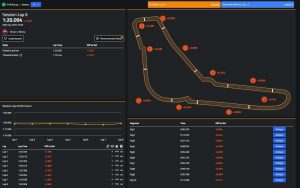
I dove into the data, using EA Racenet and Track Titan to analyse every corner. The telemetry was clear: the faster drivers were braking later, getting on the power earlier, and using every last millimetre of the track. But no matter how hard I tried to replicate it, I couldn’t find the time. I’d push for hours, feeling like I was overdriving the car to its absolute limit, and still come up short. I was at a loss.
The Catalyst: An iRacing Revelation
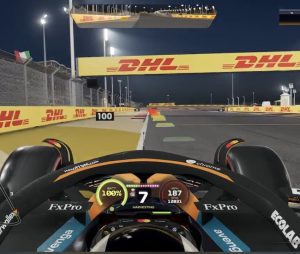
The turning point came from an unexpected place. I started dabbling in iRacing. While it has its own forms of assistance, they are far more restrictive than in titles like the F1. Suddenly, without my usual safety nets, my bad habits were laid bare. My harsh inputs on the brake and throttle, previously masked by the game, were now causing me to lock up and spin out constantly.
My current PC (a Ryzen 3200G with a 1650 GPU) struggled to run iRacing smoothly, but the lesson was learned. I decided to commit. I invested in a proper gaming PC, and with it, I made a promise to myself: I wasn’t just turning off assists for time trials or open lobbies. I was turning them off for everything, including league racing.
The Painful Truth of Learning from Scratch
I’m genuinely annoyed I didn’t do this sooner.
The first few hours were brutal. Braking felt alien. The throttle pedal felt like a hair trigger, sending me into a spin if I so much as breathed on it too hard. But I’m committed, even if it means the entirety of the F1 25 game cycle is spent pirouetting into barriers. The things I’ve learned in just a short time have been genuinely shocking.
Revelation 1: The Racing Line is a Lie
This is probably the most effective assist to turn off. It’s not just about finding a better line; it’s about actually seeing the track for the first time. We spend a lot of our hard earned money on powerful PCs and consoles for incredible graphics, only to cover it all up with a big coloured line. With it gone, you start noticing the details: the braking markers, the surface changes, the camber of the road. You stop staring at your nose cone and start learning the circuit; apex and exits, apex and exits!
Revelation 2: The Illusion of ‘Control’
When it comes to ABS and Traction Control, the secret is in the name: Control. With them turned on, the game has it. You don’t. You can stamp on the pedals, and the system sorts it out. With them off, you are in charge of modulating the brake pressure to avoid a lock-up, and you are responsible for smoothly applying the throttle to avoid wheelspin.
This is a fundamental choice. If you’re a casual player dropping in for a few 5-lap races, assists are a brilliant tool that makes the game accessible. But if you want to be truly fast and consistent, you need that raw connection to the car.
The Payoff: The Proof is in the Pace
So, was all the spinning and frustration worth it? Absolutely. And I’m not done spinning and getting frustrated just yet.
For years, I have been consistently 0.5 to 1.0 second behind my quickest friends on every Time Trial leaderboard. It felt like an impossible gap to bridge.
After less than a week with no assists, I am now within a few hundredths or even thousandths of a second of their times, and in some cases, I am beating them.
I can’t match their race pace just yet, but the improvement is staggering. What’s more, I can now feel exactly where I’m losing time. I know when I’ve braked a metre too early or gotten on the power a fraction too late. I can feel the limit of the car, something that was completely numb with assists enabled.
This will be a steep but rewarding learning curve. I’m excited to see where this journey goes.
Want to follow along? My new PC is arriving imminently, and I plan on documenting the entire process of mastering no-assist racing.
- Follow my progress live on Twitch: Twitch.tv/p1r_racing
- Connect with our community: Check out the social links here on the Home page!
It’s going to be a long road, but for the first time in years, I feel like I’m truly in the driver’s seat.
Looking to improve your lap times?
Get the AB Racing Line Engineer to find out where you’re losing time and get faster now.